The Real Cost of Poor Accountability in Shared Equipment Operations
TL;DR: Cheqroom's AssetOps platform closes the accountability gap in shared equipment operations by tying every checkout, return, transfer, and maintenance event to one record that updates automatically — no manual logging required. For broadcast, corporate AV, higher education, and healthcare teams managing gear that moves constantly between people and projects, that structure is what prevents missing equipment, double bookings, and compliance exposure. Cheqroom customers see a 25% reduction in equipment loss, and equipment managers get back 80+ hours saved per team, per month that used to go into manually tracking down gear.
Poor accountability in shared equipment operations does not announce itself. It accumulates. A piece of gear that moved without a log entry. A return that skipped the condition check. A booking that confirmed availability, the system had not updated since Tuesday. Each gap is small enough to explain away. Together, they produce something harder to dismiss: projects delayed, budgets strained, and staff spending their mornings managing exceptions instead of their work.
Shared equipment environments generate more activity than manual processes can track accurately. The gap between what the system says and what is actually happening is where accountability breaks down, and it widens every time equipment changes hands without a record.
Cheqroom's AssetOps platform closes that gap by connecting ownership, availability, condition, and scheduling into one record that updates at the point of action, for equipment managers running shared inventory across departments, crews, or campuses. This article covers what poor accountability actually costs, where the breakdown happens, and what a structured system does differently.
What Poor Accountability Actually Costs Shared Equipment Teams
The cost of poor accountability in shared equipment operations goes beyond the replacement value of missing gear. It shows up across the operation in ways that are harder to quantify but more damaging over time.
Schedule Failures and Project Delays
Double bookings, missing items, and gear that shows as available but is not in the room are the three most common causes of last-minute schedule disruptions in shared equipment environments.
A broadcast team that shows up for a live production and discovers the wireless kits were already checked out by another crew does not have ten minutes to resolve it. A corporate AV team whose projector is marked available but has been sitting in a repair queue for four days discovers the problem when the client is already in the room.
Cheqroom's 2025 State of Enterprise Asset Management report found that 34% of teams say workflow gaps directly cause project delays. Real-time visibility into equipment availability prevents exactly this, surfacing conflicts before dispatch rather than at the moment they become operational problems.
Budget Overruns From Duplicate Purchases and Emergency Rentals
Teams buy replacements for equipment that is not missing but simply invisible in an inaccurate system. Without utilization data, equipment managers cannot distinguish between genuinely lost gear and gear that is somewhere in the inventory but not tracked correctly. Both look the same: unavailable. The response to unavailability is purchase or rent, and both cost money the organization should not have spent.
A leading global broadcaster cut redundant gear purchases by 70% after gaining accurate utilization data across its full inventory through Cheqroom. The equipment had not disappeared. It had been invisible. Visibility turned a purchasing problem into a reallocation problem, which is a much cheaper problem to solve.
Damaged Equipment That Keeps Circulating
In a system without condition tracking at return, damaged equipment re-enters the available pool as soon as it is handed back. A camera with a focus issue, a microphone with an intermittent connection, a cable that works until it does not: each gets booked again, deployed again, and fails again, at the worst possible moment. The person who discovers the fault is always the next user, never the person who caused it.
The accountability gap here is not just about the damaged item. It is about the downstream costs: the failed shoot, the rescheduled session, the emergency hire of replacement gear, and the time spent investigating what should have been caught at return.
Compliance and Audit Exposure
Organizations that operate under regulatory requirements, audit obligations, or insurance terms need documented custody trails. A chain of custody that was never recorded cannot be reconstructed accurately after the fact. Government agencies, broadcasters, universities, and healthcare organizations managing regulated or high-value equipment face real liability exposure when the accountability record exists only in memory or scattered email threads.
Eroded Operational Trust
Perhaps the least visible cost is the one that accumulates in how teams relate to shared equipment systems. When coordinators cannot trust the availability record, they confirm availability by walking to the room. When equipment managers cannot attribute damage, they stop trying to hold anyone accountable.
When staff have been burned enough times by missing gear, they start hoarding equipment rather than sharing it. Each of these behaviours is a rational response to a system that cannot be trusted, and each one makes the shared equipment operation less efficient than it should be.
Why Equipment Inventory Software Isn't the Same as Cheqroom's AssetOps Platform
Equipment inventory software records what assets exist. That is useful when the equipment is static. It becomes unreliable the moment gear starts moving between people, projects, and locations at volume.
The failure modes are consistent across shared equipment environments:
No ownership enforcement: Equipment is taken and returned without a formal assignment. Without enforced checkouts, nobody is clearly responsible.
No real-time availability updates: A projector booked for two events still shows as available because the system has no reservation logic.
Disconnected from maintenance: Equipment appears available even when flagged for repair or mid-service.
No custody chain across handoffs: Multi-user transfers are invisible. The system shows the original assignment regardless of how many people have handled the item since.
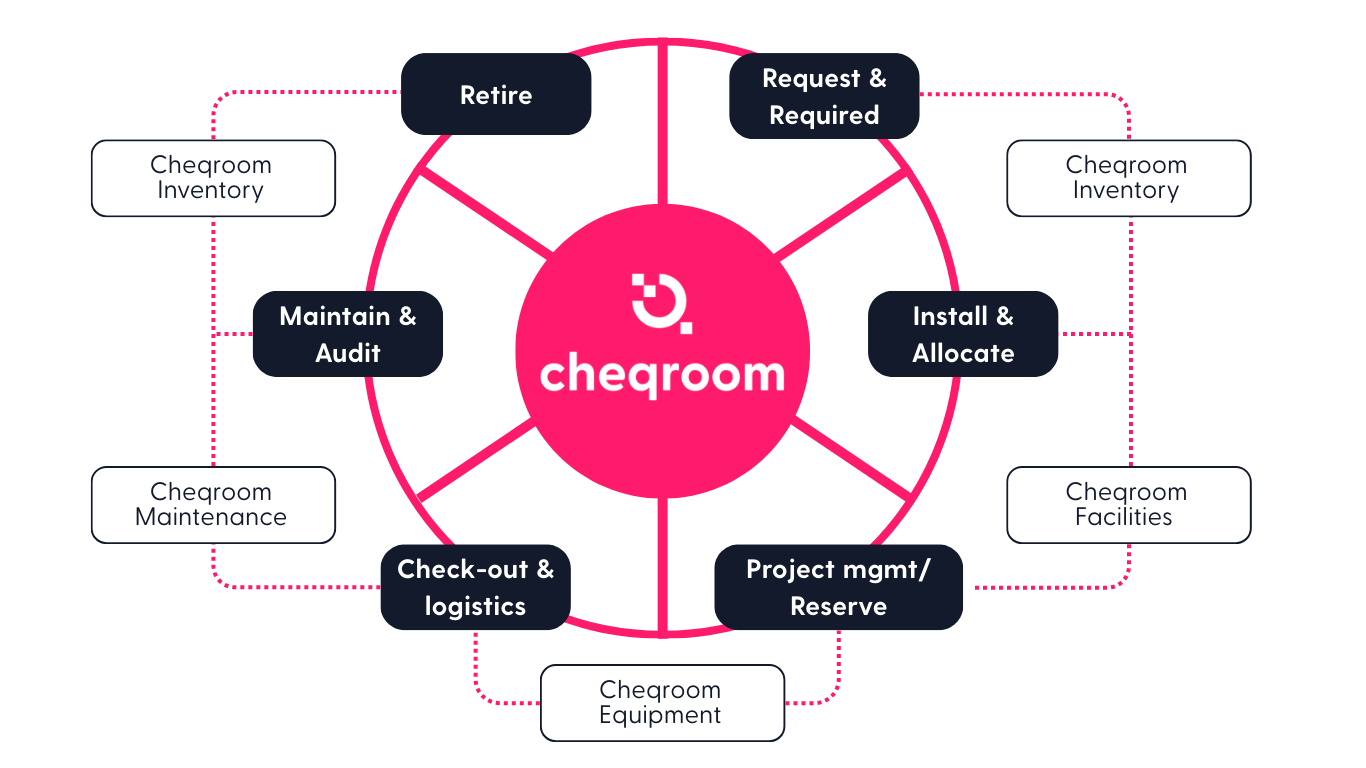
Cheqroom's AssetOps platform is built to close all four gaps at once, connecting maintenance to availability, bookings, and the full asset lifecycle, rather than treating repair tickets as a system of their own. More than 1,400+ organizations trust Cheqroom to run that connected record.
What Accountability Looks Like in a Structured Shared Equipment System
Accountability in a shared equipment environment means every asset interaction is recorded, visible, and tied to a specific person without requiring a separate decision to log it. Equipment management software built for shared environments doesn’t leave it to individual discipline - it makes the structure do the work.
Individual Assignment With Digital Checkout Agreements
Every checkout assigns the asset to a specific person, not a team or a department. That person is responsible until the return is scanned and the condition is confirmed. Digital checkout agreements signed on-device at the moment of handoff create a legally binding custody record with a timestamp.
A signature at the point of handoff changes the accountability relationship. The student or crew member who signs out a camera kit is not just borrowing it. They are acknowledging responsibility for its condition and returning in a record that carries a timestamp and holds up under audit review.
Real-Time Availability That Reflects the Full Operational Picture
Availability needs to reflect active checkouts, upcoming reservations, and maintenance blocks in one unified view. A team booking equipment for an event next week sees the current status, not the status from whenever the record was last manually updated.
Double bookings get blocked before they happen rather than discovered at dispatch. The right equipment for a project or event is confirmed available before anyone commits to a schedule, not after they arrive and find the room empty.
💡TIP
Cheqroom's availability view combines reservations, active checkouts, and maintenance blocks in one calendar. A coordinator confirming gear for a shoot tomorrow sees everything: what is out, when it comes back, what is blocked for service, and what is genuinely available. No separate systems to check.
Maintenance Flags That Automatically Update Availability
An asset flagged for repair is automatically pulled from bookable inventory the moment the flag is raised. No manual calendar hold. No separate system update. The flag and the availability block are the same action. An admin is automatically notified of the issue. The team can initiate a work order directly in the system, assign it to a technician, and track the repair to completion, at which point the asset returns to circulation automatically.
Configurable Access Controls and SSO
Not every user should have access to every piece of equipment. Role-based permissions restrict advanced or high-value gear to qualified users. A first-year student cannot book an ARRI camera. A junior technician cannot modify maintenance records. SSO integration through Okta, Microsoft Entra ID, Google, or Shibboleth means access is governed at the identity level, not just the application level. When a student graduates or an employee leaves, their access is revoked through the identity provider rather than requiring a manual update in the equipment system.
Complete Audit Trails Built Into Daily Operations
Audit trails record every checkout, return, transfer, condition change, and maintenance event with a user identity and timestamp. The custody history builds itself through normal operations rather than requiring manual reconstruction before a review. Insurance claims, compliance submissions, and departmental audits become documentation pulls rather than investigations. A leading global broadcaster reduced compliance prep time by 60% after centralizing custody records in Cheqroom.
💡TIP
Cheqroom's audit trails are non-editable and complete. Every status change carries the user who made it and the time it occurred. For regulated industries and compliance-heavy operations, that immutability is what makes the record defensible rather than just informative.
Where Accountability Breaks Down Most Often
Shared equipment accountability does not fail evenly across the operation. It fails at specific, predictable points. Understanding where helps teams prioritize where a structured system makes the biggest difference.
Informal transfers between users: Gear passed between colleagues without a logged handoff creates an invisible movement. The system still shows the original checkout user as responsible. The actual current holder is unknown. When the item does not come back, the trail ends at the last logged event.
Returns that skip condition checking: A quick return at the end of a long shift bypasses the condition step. The asset logs as returned and immediately re-enters the available pool. The next user discovers the damage at the worst possible time.
Maintenance flags that do not update availability: A note in a spreadsheet or a verbal report to a coordinator does not remove an asset from the booking system. The item stays available. It gets booked. It gets checked out. It fails.
Access without assignment: Equipment picked up without a formal checkout creates no record and no responsibility. The person who took it is unknown to the system. If it does not come back, there is nowhere to start looking.
Accountability Is Not a Policy Problem. It Is a System Problem.
The teams dealing with missing gear, double bookings, and damaged equipment circulating through their inventory are not failing because they do not care about accountability. They are failing because their systems were not built to maintain it at the pace and volume at which shared equipment actually moves.
Cheqroom's AssetOps platform doesn't ask people to be more careful. It makes careful the default by connecting every checkout, return, transfer, and maintenance event into a single record that updates automatically. The accountability is structural. The gaps that were producing delays, budget overruns, and compliance exposure are closed because the system leaves no space for equipment to move without being tracked.
See how Cheqroom builds accountability into shared equipment operations.
Meet Maria Fernanda Benitez, our Marketing Specialist driving Cheqroom’s voice and performance. Mafe blends creativity with data, shaping content, managing social media, and supporting operations while keeping a close eye on what actually works.
She has a natural instinct for trends and performance and loves turning insights into smarter decisions. Her favorite part? Brainstorming, optimizing, and making every idea count.
What Does Poor Accountability Cost Shared Equipment Teams?
The direct costs include replacement of missing or damaged gear, emergency rental to cover unavailable equipment, and budget spent on duplicate purchases for items that are in the inventory but not tracked correctly. The indirect costs include project delays from double bookings and unavailable gear, staff time absorbed by manual follow-up and reconciliation, compliance exposure from incomplete custody trails, and the gradual erosion of trust in the shared equipment system itself.
How Does Shared Equipment Management Software Prevent Double Bookings?
Shared equipment management software prevents double bookings by maintaining a single availability record that reflects active checkouts, upcoming reservations, and maintenance blocks simultaneously. A team booking equipment sees the current status, not a cached snapshot. Reservation rules block conflicting bookings before they are confirmed rather than flagging them after dispatch. The right gear for a project is confirmed available before anyone commits to a schedule.
What Is the Difference Between Equipment Inventory Software and Cheqroom's AssetOps Platform?
Equipment inventory software records what assets exist. Cheqroom's AssetOps platform manages how those assets move between people, projects, and locations, including maintenance, but connected to bookings and lifecycle rather than as a standalone repair log. Inventory software tells you what you own. Cheqroom tells you who has it, what condition it is in, whether it is available to book, and whether it is cleared for use. In shared equipment environments where gear changes hands frequently, that second set of questions is the one that determines whether operations run smoothly.
How Do Digital Checkout Agreements Improve Accountability?
Digital checkout agreements signed on-device at the moment of handoff create a legally binding custody record tied to a specific user with a timestamp. The user acknowledges responsibility for the equipment's condition and return. That record holds up under compliance review, supports insurance claims, and gives organizations a defensible chain of custody when disputes arise over damage or loss.
How Does Cheqroom Handle Access Controls for Shared Equipment?
Cheqroom uses role-based permissions to restrict equipment access by user level, department, or certification. SSO integration through Okta, Microsoft Entra ID, Google, and Shibboleth governs access at the identity level. Custom roles can be configured to match how the organization actually governs its equipment: who can book, who can approve, who can modify records, and who can access restricted gear.