Why You Can't Vibe Code Your Equipment Operations
Automation is only as good as the data powering it. Here's what AI workflow tools get wrong about physical assets — and what they need to get it right.
Someone on your team has already tried it.
A ChatGPT script to track gear checkouts. A Notion database with Zapier bolted on. Maybe a weekend project in Cursor that genuinely looked impressive in the demo. It pulled data from a spreadsheet, sent Slack notifications, and generated a neat dashboard.
It worked great. For about two weeks.
Then someone checked out a camera kit, another team reserved the same kit for a shoot the next morning, a lens got flagged for maintenance mid-reservation, and the whole system quietly stopped making sense. Nothing broke loudly. It just started producing answers that were probably right – which is exactly the problem.
Vibe Coding Is Genuinely Good at a Lot of Things
AI workflow tools are real, they're fast, and for a wide range of business problems, they're exactly the right approach. Need to parse a CSV and generate a report? Build it in an afternoon. Need a custom bot that routes support tickets or updates a project board? Great use case.
AI-built tools are powerful. The real question is whether they’re the right architecture for equipment operations.
The reason is a fundamental gap between what AI tools are built to do and what running physical operations actually requires.
The Physical Reality Gap
AI workflow tools are excellent at moving data. What they don't have is any awareness of the physical world.
An AI agent can see a digital record of a camera. It cannot know whether that camera is in the studio, in a freelancer's bag, or currently overheating due to a faulty sensor. It cannot know whether the kit's sub-components are all present, or whether a flagged item was actually cleared before it got checked back in.
This isn't a limitation you can engineer around with a better prompt. It's structural. Generic AI tools and automation platforms treat physical assets as data records — items in a database with statuses that update when someone remembers to update them. In reality, equipment moves, degrades, gets misplaced, and changes hands dozens of times a week in ways that never make it back to a spreadsheet.
When AI reasons over incomplete, stale data, it doesn't tell you it's guessing. It gives you an answer. For a content recommendation or a meeting summary, a probabilistic answer is fine. For a $50,000 cinema camera that needs to be on a shoot tomorrow morning, a "95% likely to be in Studio B" is a 100% operational failure.

The Rise of Asset Operations Platforms
The gap between digital workflows and physical reality is exactly why a new category of software has emerged: Asset Operations platforms.
AssetOps systems are built for environments where equipment moves constantly between people, locations, and projects for teams like film production, universities, hospitals, event crews, and field operations.
Instead of treating assets as static inventory records, AssetOps platforms track the full operational lifecycle of equipment:
- reservations
- checkouts and custody transfers
- maintenance and condition tracking
- kit relationships between components
- real-time availability
In other words, they manage complex and interconnected operations, not just inventory.
Why Specialized Logic Beats Generic Automation
What most vibe-coded equipment trackers miss is this: the hard part isn't the database. It's the workflow logic that sits underneath.
Reservations and checkouts are in different states. An item can be reserved for tomorrow while still checked out today, and those states must coexist correctly. A flagged item should be excluded from availability even if it's technically "back in." A kit has sub-components (cables, batteries, lenses) that move together but need to be tracked independently for maintenance, loss, and accountability. A custody transfer needs a timestamped record that holds up under audit or insurance claim.
None of this is exotic. It's just a normal Tuesday in equipment operations.
Generic AI workflow tools see everything as a task: Step A triggers Step B. They don't understand the specialized logic that governs how physical assets actually move through an organization.
| Generic AI Workflow Tool | Cheqroom (AssetOps) | |
|---|---|---|
| Physical Reality | No awareness of broken/missing items | Real-time status & condition tracking |
| Asset Logic | Treats everything as a generic task | Understands kitting, maintenance, reservations |
| Audit Trails | Transactional only | Full custody lifecycle & human accountability |
| Hardware Integration | Requires manual data inputs | Native barcode/QR/RFID & API sync |
| Accountability | Soft (notifications) | Hard (signatures & custody chains) |
| Data Integrity | Probabilistic (guesses) | Deterministic (verified) |
Cheqroom Isn't an Alternative to AI. It's the Fuel.
This isn't a case against AI. It's a case for using AI where it actually creates leverage.
AI tools are "garbage in, garbage out" engines. If your operational data is trapped in Slack threads, email chains, and spreadsheets, captured hours after the fact, inconsistently, by whoever remembered to update the doc, then AI isn't solving your equipment problem. It's automating your mess faster.
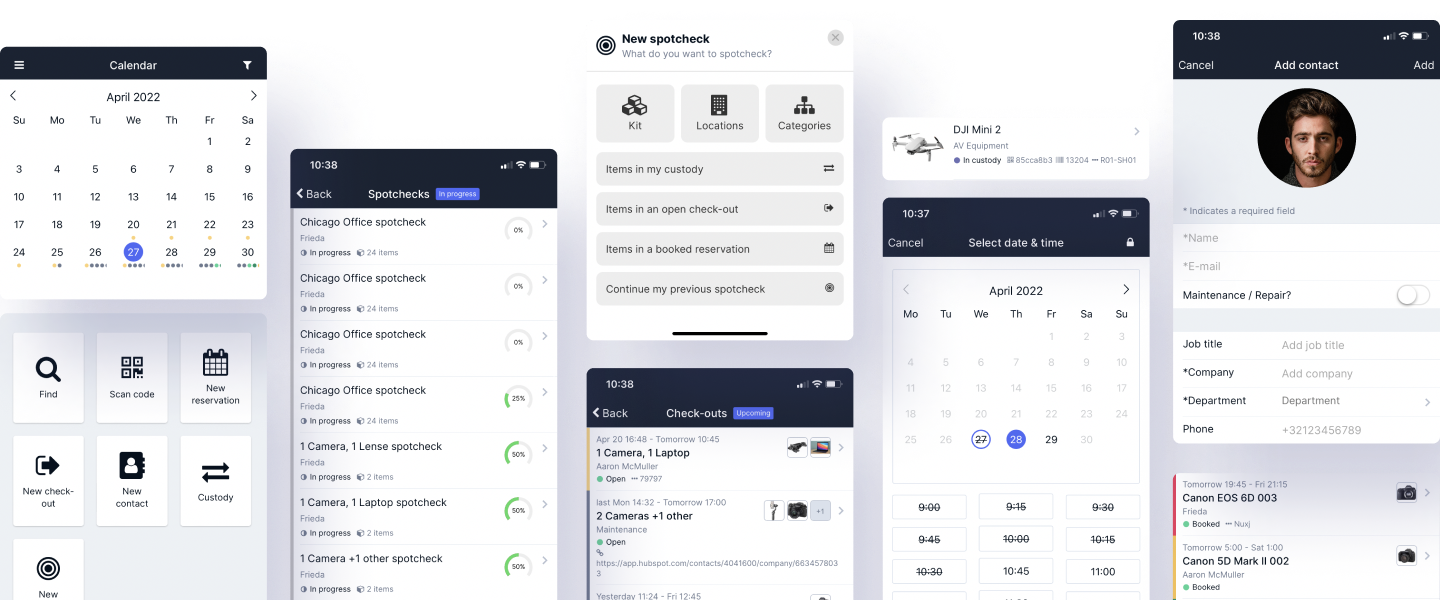
Cheqroom captures data differently. Every checkout, reservation, custody transfer, and maintenance flag is recorded at the exact moment it happens, by the person doing it, on mobile, at the point of action. That creates a verified, structured, real-time data stream — not "probably available," but available. Not "should be with the production team," but confirmed checked out to this person at 9:14am.
That's the Ground Truth that makes AI genuinely powerful on physical operations:
- Predictive maintenance works when the system knows actual usage hours, not estimated ones
- Automated fulfillment works when the system knows real-time asset state, not last week's inventory count
- Intelligent availability works when the system has a verified audit trail, not a spreadsheet someone last touched on Thursday
The right picture isn't Cheqroom versus AI workflows. It's Cheqroom underneath them.
What "Better Together" Actually Looks Like
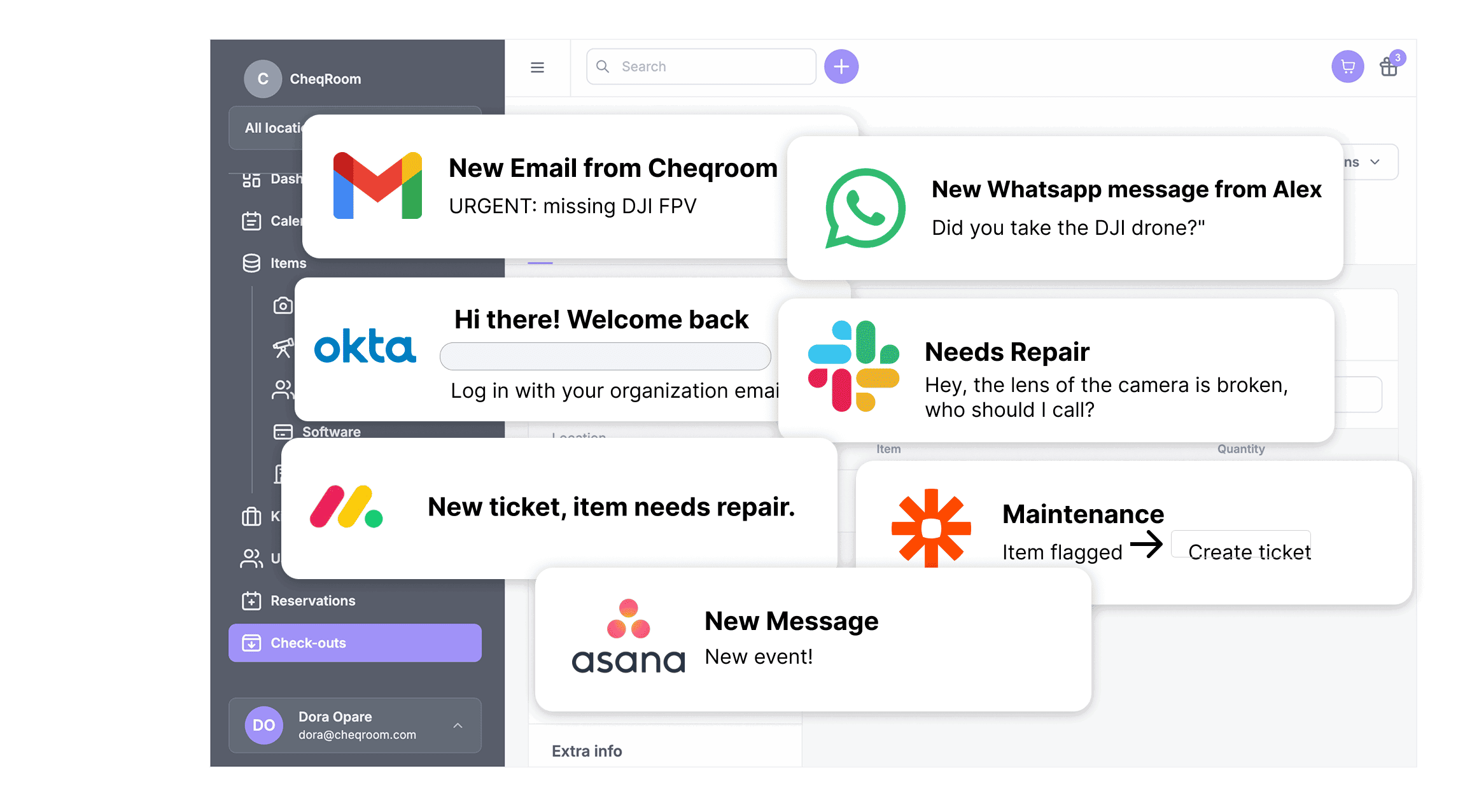
For example, A production coordinator makes a reservation in Cheqroom for a camera kit needed on Friday's shoot. That single action can trigger an AI workflow that:
- Notifies the coordinator via Slack that the reservation is confirmed
- Updates the production's project board with the gear status
- Sends a reminder to the equipment manager 24 hours before pickup
- Flags the reservation for review if any sub-component is under a maintenance hold
But notice what's doing the heavy lifting: Cheqroom is providing verified physical state at every step. The AI workflow handles human communication. Cheqroom handles physical reality. Neither works as well without the other — and the AI layer only works at all because the data underneath it is clean, real-time, and trustworthy.
That's the architecture of an operations team that's actually running well.
You Can't Workflow Your Way Out of Missing Data
There's a tempting shortcut: if we automate the workflow, we don't need a dedicated asset tool.
It's the same logic that makes open-source asset management look attractive — no licensing fees, full flexibility, build exactly what you need. Until you factor in the hosting, the maintenance, the security burden, the custom development every time your operations change, and the support costs that quietly accumulate. We broke down exactly how those hidden costs add up in a separate piece, and the pattern is the same: what looks like savings at the start becomes a cost center by the end of year one.
Vibe coding is the 2025 version of the same trap. The script is free. The ops manager's time cleaning up after it isn't.
The reality is the opposite. If your underlying asset data is messy, your AI will automate the mess. Automating a flawed process doesn't fix the flaw — it just makes failures happen faster and at a greater scale.
Teams that run equipment operations well aren't the ones who built the cleverest script. They're the ones who stopped doing manual coordination work — the endless Slack pings, the "where's the gear?" hunts, the spreadsheet reconciliations that eat 20 hours a week — and got that time back. Cheqroom customers save an average of 80 hours per month and reduce equipment loss by up to 45%. Not because the software is magic. Because it's built specifically for this problem, with the operational logic that generic tools will never develop.
Build With AI. Run Operations on the Right Foundation.
Use AI everywhere you can — there are genuinely great applications for it across your stack, and some of the most powerful ones involve Cheqroom as the data layer underneath.
But for the equipment your team depends on — gear that can't be late, can't go missing, and can't be unaccounted for when an audit needs to pass or a claim needs to be filed — that's not a vibe coding problem.
This is exactly why Asset Operations platforms exist.
They provide the operational system of record for physical equipment — the layer that captures real-world state so automation and AI can actually work.
Without that foundation, you're just automating guesses.

Make your AI workflows actually work
Want to see how Cheqroom provides the data layer to power your automation?

Maria Alejandra Benitez Chief of Staff at Cheqroom | Equipment Management Expert! Maria is the strategic mind shaping Cheqroom’s big-picture moves. As Chief of Staff, she turns industry insights into go-to-market gold—bridging customer needs, product vision, and smart execution.
With a deep pulse on equipment-heavy industries and a sharp eye for market trends, she helps Cheqroom stay three steps ahead. Whether it’s unlocking new verticals or fine-tuning product-market fit, Maria’s the one connecting the dots (and making it look easy).
She’s all about bold strategy, smart growth, and making gear management way cooler than it sounds.
More blog articles